 Ultimate guide
Leadership Development for Industrial Sectors: A Guide
Table of Contents
- Why Leadership Development Matters in Industrial Organizations
- Manufacturing Leadership Competencies That Drive Results
- Frontline Leadership Training for Manufacturing: Building Your Pipeline
- Creating a Leadership Development Plan Template for Your Organization
- Leadership Development Program Examples: What Actually Works
- Moving From Awareness to Sustained Behavior Change
- Measuring Impact and Building Your Business Case
- Conclusion: The Rhythm of Industrial Leadership
- Frequently Asked Questions
Last Updated: October 11, 2026
Why Leadership Development Matters in Industrial Organizations
Leadership effectiveness directly shapes operational performance, safety outcomes, and employee retention in manufacturing and industrial environments.
The challenge isn't finding leaders, it's developing them intentionally before crisis forces you to promote someone unprepared. Many organizations promote their best technician or engineer into a supervisory role, assuming technical competence translates to leadership competence. It doesn't.
Effective leadership in industrial sectors requires intentional, repeated behaviors: how you communicate safety expectations, how you respond when something goes wrong, how you coach a struggling employee, how you make decisions under time pressure. These interactions have a rhythm.
Organizations with strong leadership pipelines often experience positive outcomes like lower turnover, fewer safety incidents, higher productivity, and better employee engagement. Weak leadership development can create gaps that become crises: sudden departures, critical positions left unfilled, and institutional knowledge walking out the door.
Manufacturing Leadership Competencies That Drive Results
What does effective leadership actually look like on a manufacturing floor or in an industrial facility?
Communication and clarity matter most.
Emotional intelligence and people management determine whether a leader can read the room, stay composed under pressure, and adjust their approach.
Decision-making and problem-solving under constraints is central to industrial leadership. Leaders face incomplete information, competing priorities, and time pressure.
Accountability and follow-through create the rhythm that makes systems work.
Coaching and developing others builds your pipeline. A supervisor who identifies potential, gives honest feedback, and creates stretch opportunities multiplies their impact.
Frontline Leadership Training for Manufacturing: Building Your Pipeline
Frontline supervisors and shift leaders are the backbone of manufacturing operations. Yet many organizations invest minimally in developing them, treating the role as a stepping stone rather than a critical leadership position.
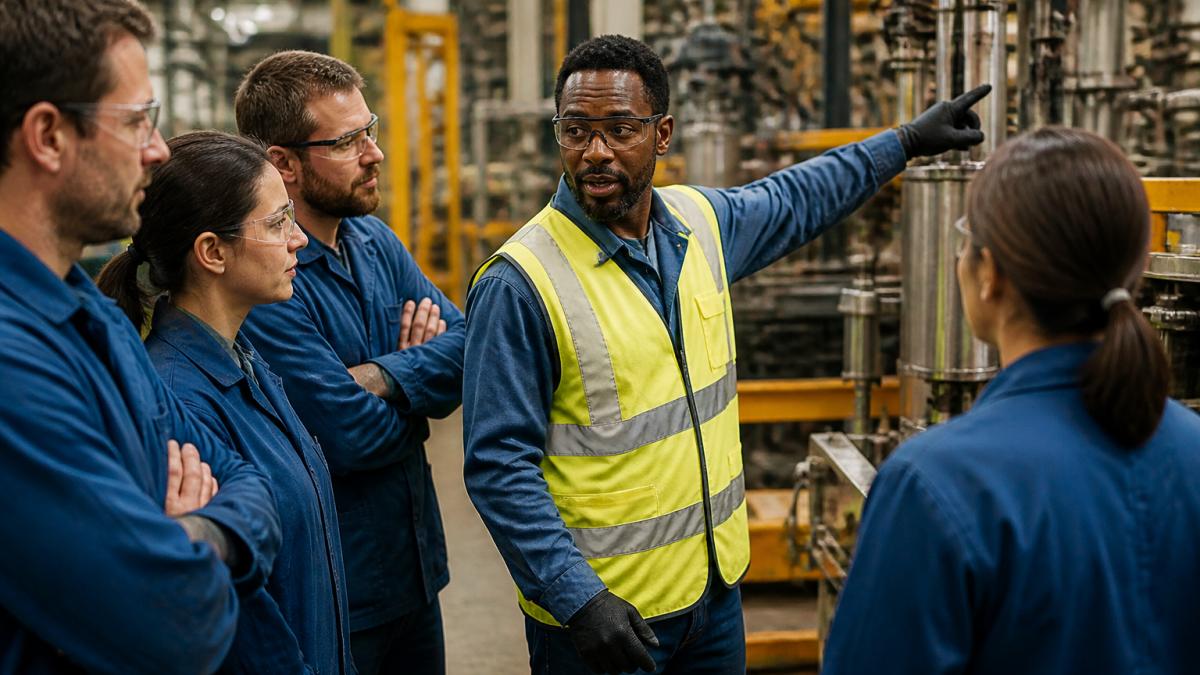
Effective frontline leadership training for manufacturing addresses the realities of shift work, production pressure, and safety-critical environments. It's tailored to where these leaders actually work.
Structured training should include:
-
Safety leadership and risk awareness - How to create a culture where safety is non-negotiable, not just compliance theater. How to have conversations about near-misses and incidents without blame. How to model safe behavior consistently.
-
Operational decision-making - How to prioritize competing demands (quality vs. speed, safety vs. schedule pressure). How to escalate problems appropriately. How to make decisions with incomplete information and stand by them.
-
Difficult conversations and conflict resolution - How to address performance issues directly. How to handle personality conflicts between team members. How to deliver feedback that sticks without damaging relationships.
-
Coaching and feedback skills - How to identify potential in someone. How to give feedback that develops rather than demoralizes. How to create stretch assignments that build capability.
-
Communication and clarity - How to translate plant strategy into meaningful work. How to run effective team meetings. How to listen for what's not being said.
Training can be more effective when it combines initial workshops with ongoing reinforcement. A two-day event can create awareness; sustained development with coaching, peer learning, and accountability can create behavior change.
Creating a Leadership Development Plan Template for Your Organization
A leadership development plan template moves from "we should develop our leaders" to specific, measurable actions tied to individual roles and organizational needs.
A practical template should include:
| Element | Purpose | Example |
|---|---|---|
| Current Role & Responsibilities | Baseline for what the leader manages today | Plant Supervisor, 2nd Shift, 45 people |
| Target Role/Level | Where the leader is heading | Plant Manager or Senior Supervisor |
| Key Competency Gaps | Specific skills to develop | Strategic thinking, budget management, conflict resolution |
| Development Actions | How gaps will be addressed | Executive coaching, cross-functional project, leadership course |
| Timeline | Realistic milestones | 90 days for awareness, 12 months for behavior change |
| Success Measures | How you'll know it's working | 360-degree feedback, retention metrics, performance outcomes |
| Owner & Accountability | Who drives the plan | Direct manager + HR partner |
The template matters less than the conversation it enables. A good plan emerges from dialogue between the leader, their manager, and HR. Plans created in a vacuum become documents that gather dust.
A development plan needs teeth. It's a commitment with consequences. If a leader agrees to coaching and doesn't show up, that's a signal. Accountability for development moves you from training culture to learning culture.
Leadership Development Program Examples: What Actually Works
Program design that works typically includes:
-
Executive coaching for senior leaders - One-on-one coaching focused on strategic thinking, executive presence, and leadership transitions. Coaching can be effective because it's personalized and addresses specific challenges in the leader's actual role.
-
Peer learning cohorts for emerging leaders - Groups of 8-12 emerging leaders who meet monthly to discuss real challenges and hold each other accountable. This builds community and creates accountability that formal training doesn't.
-
360-degree feedback and assessment - Leaders get feedback from their manager, peers, and direct reports on how they're perceived. This creates awareness of blind spots and gives them a baseline to measure growth against.
-
Cross-functional projects and stretch assignments - Leaders develop new capabilities by working outside their functional area. Stretch assignments can build capability (Develop Strong Leaders With On-the-Job Learning).
-
Structured mentoring - Pairing emerging leaders with experienced leaders creates knowledge transfer. The best mentoring is specific and tied to real problems.
-
Workshops on critical skills - Focused, skill-building workshops on specific competencies like difficult conversations, decision-making under pressure, or safety leadership. Workshops work best when they're reinforced with follow-up coaching and peer accountability.
Programs that work share a common thread: they're sustained, reinforced, and tied to business outcomes. A one-time workshop doesn't cut it. Emerging supervisors need different development than plant managers. Frontline leaders in safety-critical environments need different focus than those in less-regulated roles.
Moving From Awareness to Sustained Behavior Change
Leadership development can sometimes fall short by creating awareness without leading to behavior change.
Behavior change requires something different. It requires:
Clear expectations. The leader knows specifically what behaviors they need to change. Not "be a better communicator," but "ask questions before jumping to solutions" or "check in one-on-one with each direct report weekly."
Practice and feedback. The leader practices the new behavior and gets feedback on how it's working.
Accountability. Someone checks whether the leader is actually doing the work. This might be a coach, their manager, or a peer learning group.
Reinforcement. The new behavior gets reinforced by results.
Without these elements, awareness can fade and behavior may revert. The gap between knowing and doing is where many development efforts can lose momentum.
One-off training often doesn't lead to lasting change.
Measuring Impact and Building Your Business Case
If you're investing in leadership development for industrial sectors, you need to know whether it's working, not just whether people feel good about training, but whether it's moving business outcomes.
Measure at multiple levels:
Level 1: Reaction. Did people find the training useful? This is easiest to measure and least meaningful.
Level 2: Learning. Did people understand the concepts? This matters, but it's not enough.
Level 3: Behavior. Are leaders changing how they work? Are they having difficult conversations and coaching differently?
Level 4: Business outcomes. Is the organization seeing results? Lower turnover? Fewer safety incidents? Higher productivity? Better quality?
Track metrics that matter in your context:
- Retention of high-potential leaders - Are emerging leaders staying?
- Internal promotion rates - Are you filling roles from within?
- Safety performance - Are incident rates declining? Is near-miss reporting increasing?
- Productivity and quality metrics - Are operations running more smoothly?
- Employee engagement - Are team members more engaged?
- Time to productivity for new supervisors - How quickly do newly promoted leaders reach full effectiveness?
Building a business case means connecting metrics to investment.
Many organizations skip measurement because it feels complex.
Conclusion: The Rhythm of Industrial Leadership
Leadership development for industrial sectors isn't a problem to solve with a single program.
Organizations that excel in areas like safety, productivity, and retention often build leadership development into their operational rhythm.
Dr. Terry Daniels | The Rhythm Coach works with manufacturing and industrial leaders to build sustainable leadership development that creates behavior change, not just awareness.
Start a conversation with Dr. Terry Daniels about building your leadership development approach.
Frequently Asked Questions
What makes leadership development for industrial sectors different from generic leadership programs?
Industrial leadership faces unique pressures: safety compliance, continuous production demands, shift-based teams, and frontline supervisors managing technical work under tight margins. Generic programs ignore these realities. Effective leadership development for industrial sectors must address safety culture, operational decision-making, shift-based communication rhythms, and the specific emotional intelligence skills frontline leaders need when managing high-stakes, safety-critical environments. One-off workshops miss this entirely.
What manufacturing leadership competencies should we prioritize in our development program?
Focus on these core manufacturing leadership competencies: safety mindset and risk awareness, operational decision-making under pressure, clear communication across shift changes, emotional intelligence with diverse teams, accountability for quality and productivity metrics, and adaptability to changing production demands. These competencies directly impact safety incidents, quality, throughput, and retention. Develop them through practice, feedback, and reinforcement, not just classroom training. Leaders need to apply these skills immediately on the floor.
How do we actually make frontline leadership training for manufacturing lead to lasting change?
Awareness alone often doesn't stick. Frontline leadership training for manufacturing can be more effective when it includes on-the-job application, regular feedback from peers and supervisors, accountability for using new skills, and reinforcement over months, not days. Pairing training with coaching, peer discussion, and measurable goals tied to safety, quality, or engagement metrics can help. Building it into the leadership rhythm through regular check-ins and team discussions can also be beneficial. When leaders practice new behaviors consistently and see results, behavior change is more likely to hold.
What should a leadership development plan template include for our organization?
A strong leadership development plan template should include: clear competency gaps assessed through 360-degree feedback or leadership assessment, specific learning objectives tied to business outcomes, development activities (coaching, training, stretch assignments, peer learning), timeline and milestones, accountability measures, and how progress will be tracked. For industrial settings, include safety leadership, operational decision-making, and communication rhythm as core elements. The template should be flexible enough to adapt to different levels (frontline, mid-level, senior) and different production environments.
How can we measure whether our leadership development program examples are actually working?
Measure at multiple levels: Did leaders apply what they learned (behavior change)? Did safety incidents, quality metrics, or engagement scores improve? Did retention of high-potential leaders improve? Did operational performance (throughput, downtime, waste) move? Avoid relying solely on training satisfaction scores; those don't predict behavior change. Track specific metrics tied to your business goals before, during, and after the program. Ask frontline employees whether their supervisor's communication or feedback improved. Real impact shows up in business outcomes and team feedback, not just participant evaluations.
Why do leadership training programs often fail to create lasting change in industrial organizations?
Many programs treat leadership development as an event, rather than an ongoing rhythm. Leaders might attend a workshop, feel energized for a week, then return to old patterns if there's no reinforcement, accountability, practice structure, or feedback loop. Industrial environments move fast and demand immediate focus on production. Without ongoing coaching, peer accountability, and visible progress on real business problems, new behaviors can fade. Sustainable change often requires intentional, repeated practice over months. Leaders need to see the connection between their new behaviors and safer operations, better quality, or stronger team engagement.
How do we build a leadership pipeline in manufacturing when we're losing supervisors to burnout or retirement?
Start identifying and developing emerging leaders now, before vacancies force rushed promotions. Create a structured pipeline: identify high-potential frontline employees, assess their readiness for greater responsibility, pair them with mentors or coaches, give them stretch assignments, and develop the specific competencies they'll need in the next role. Focus on safety mindset, decision-making under pressure, and people management. Use a leadership development plan template tailored to manufacturing roles. Involve current leaders in mentoring and feedback. This takes time, but it prevents the costly cycle of promoting unprepared leaders and losing institutional knowledge.