 how-to
Why Traditional Leadership Training Fails—and What Creates Lasting Behavior Change.
Table of Contents
- Why Traditional Leadership Training Fails: The Core Problems
- Why One-Off Workshops and Events Do Not Create Lasting Change
- The Missing Link: Post-Training Support and Follow-Up
- The 70-20-10 Model for Leadership: What Most Organizations Get Wrong
- Leadership Coaching vs Training: Why the Distinction Matters
- Leadership Development Best Practices That Actually Work
- How to Measure ROI and Prove Leadership Development Works
- Conclusion: Building Leadership Rhythms That Last
- Frequently Asked Questions
Last Updated: September 26, 2026
Why Traditional Leadership Training Fails: The Core Problems
Most leadership training fails because it treats every leader the same. It delivers theory in a classroom, then sends people back to a job that looks nothing like the workbook. The same story repeats across industries: big spend, short spike, slow fade.
The research on why traditional leadership training fails points to a handful of core problems. They show up again and again, no matter the company size or sector.
Harvard Business Review on why leadership training often fails has documented this pattern for years: leaders learn something useful, then lose it because nothing in their daily routine changes.
Here's the short version of what goes wrong:
- Programs ignore each leader's context and experience
- Content stays theoretical instead of practical
- Events are one-off, not ongoing
- Follow-up and support are missing
- Goals are vague, so results can't be measured
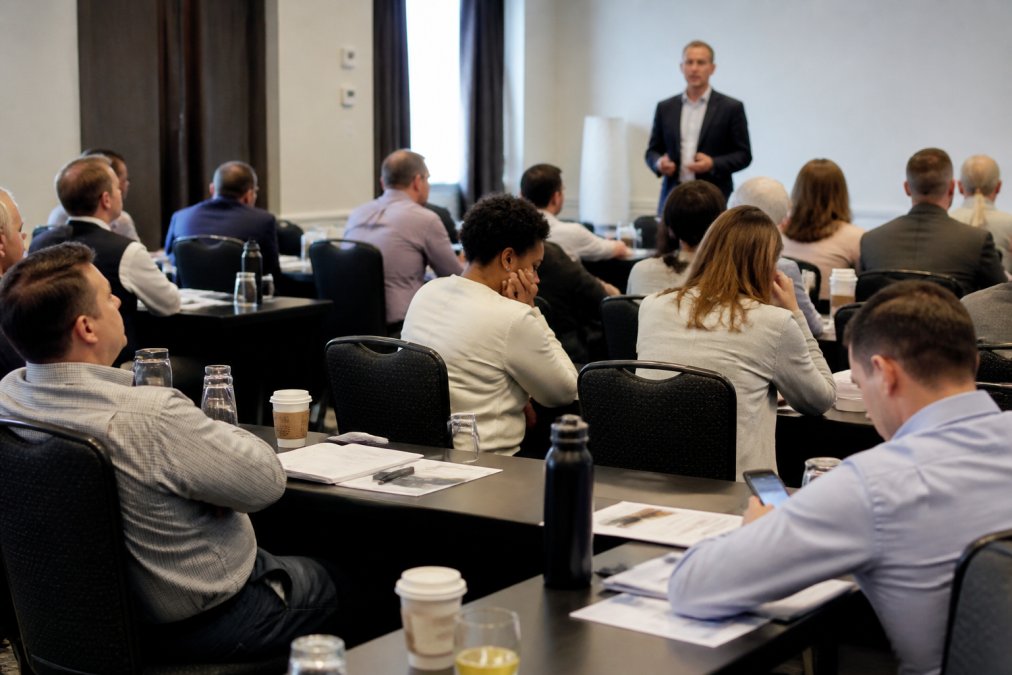
One-Size-Fits-All Programs Ignore Context and Experience
A one-size-fits-all program assumes a 20-year manufacturing VP and a first-time team lead need the same content. They don't.
A common mistake is buying a packaged curriculum and running every leader through it. The veteran tunes out because the material feels basic. The new manager feels lost because the examples don't match their world.
Leadership development works when it fits the leader's actual role, industry, and skill gap. That means a skill gap analysis first, then a plan built around it.
The Gap Between Theory and Real-World Application
The classroom teaches concepts. The job demands judgment calls under pressure.
That gap is where most training dies. A leader can explain a feedback model on a Tuesday and still avoid a hard conversation on a Wednesday. Knowing the framework isn't the same as using it.
Experiential learning closes that gap. Leaders practice on real problems, get feedback, and adjust. That's how knowledge application turns into skill.
Why One-Off Workshops and Events Do Not Create Lasting Change
One-off workshops fail because a single event cannot build a habit. You can't learn to lead in a day any more than you can learn to play an instrument in one lesson.
The energy is real. People leave motivated. Then the calendar fills up, old patterns return, and the workbook goes in a drawer. Nothing about the leader's daily rhythm changed.
Sustained behavioral change needs repetition, feedback, and time. A workshop can plant a seed. It can't grow the plant.
The Forgetting Curve: Why 70% of Training Is Lost in a Week
The forgetting curve describes how quickly people lose new information without reinforcement. Much of what's taught in a single session fades within days.
That's not a motivation problem. It's how memory works. Without practice and follow-up, the brain files the content as "not needed" and lets it go.
The fix is spacing. Short, repeated practice beats one long session every time. This is the same principle behind habit formation in leadership: small actions, repeated often, become automatic.
The Missing Link: Post-Training Support and Follow-Up
Post-training support is what turns a lesson into a habit. Without it, most programs end the moment the room empties, and the research on habit formation explains exactly why.
Behavioral scientists describe a habit loop: cue, routine, reward. A training event introduces a new routine, but the leader's existing cues and rewards don't change. Back at the desk, the old cue (a tense meeting, a missed deadline) triggers the old routine (avoid the conversation, micromanage the task) because that routine still delivers a familiar reward (short-term relief). The new behavior has no cue and no reward yet, so the brain discards it. This is the neurological reason "motivation fades", it isn't motivation at all. It's an unbuilt habit loop.
That's why follow-up isn't a nice-to-have. It's the mechanism that installs the cue and attaches the reward. Effective follow-up has four moving parts:
- Cue design: Tie the new behavior to an existing trigger. "Before every Monday stand-up, I will ask one coaching question" beats "I will coach more."
- Deliberate practice: Short, repeated reps on real work. Ten minutes of practice three times a week outperforms a three-hour refresher once a quarter.
- Immediate feedback: A coach or peer who observes the behavior and responds within days, not at the next quarterly review.
- Reward substitution: Make the new behavior feel good fast, recognition, visible progress, a team that responds differently.
Mentorship and coaching culture matter more here than any curriculum. A leader who gets honest feedback every week improves faster than one who attends a great seminar once a year. The cadence is the intervention.
A practical follow-up architecture most organizations can run:
Timeframe | Activity | Purpose |
|---|---|---|
Week 1 | 30-minute coaching call | Set one specific behavior goal with a cue |
Weeks 2-4 | Peer accountability check-in | Report one attempt, one obstacle, one adjustment |
Day 30 | Manager observation | Confirm the behavior is showing up in real work |
Day 60 | 360 pulse | Measure whether others notice the change |
Day 90 | Review against baseline | Decide whether to scale, adjust, or stop |
Harvard Business Review on why leadership training often fails has documented this pattern for years: leaders learn something useful, then lose it because nothing in their daily routine changes.
The unique angle most programs miss: follow-up isn't administrative cleanup. It's the habit-formation engine. Design it with the same rigor as the curriculum, and the forgetting curve stops being the enemy.
The 70-20-10 Model for Leadership: What Most Organizations Get Wrong
The 70-20-10 model for leadership suggests leaders develop mostly through on-the-job experience, some through relationships and mentorship, and a small share through formal training.
Most organizations flip that ratio. They spend the bulk of their budget on classroom events, then wonder why behavior doesn't change.
What most guides miss is the sequencing. Formal training works best as a small input that supports the other two.
Development Source | Share of Growth | What It Looks Like |
|---|---|---|
On-the-job experience | Largest share | Stretch projects, new responsibilities |
Relationships and mentorship | Middle share | Coaching, peer feedback, role models |
Formal training | Smallest share | Workshops, courses, certifications |
Leadership Coaching vs Training: Why the Distinction Matters
Leadership coaching vs training is a distinction most organizations blur. They are not the same tool, and they solve different problems.
Leadership Development Best Practices That Actually Work
Leadership development best practices share one trait: they build habits, not events. They treat growth as a system that runs all year. But the best practices list, clear objectives, skill gap analysis, measurable outcomes, misses the two forces that quietly kill most programs: middle management resistance and the absence of psychological safety.
- Start with a clear strategic objective, not a course catalog
- Run a skill gap analysis before choosing any program
- Tie every initiative to business outcomes you can measure
- Build a competency framework so expectations are clear
- Use experiential learning on real problems
- Add coaching and mentorship for every participant
- Track progress with performance metrics, not attendance
- Enroll middle managers as co-owners, not passive recipients
- Establish psychological safety before asking anyone to practice
How to Measure ROI and Prove Leadership Development Works
Measuring ROI starts before the program does. You need a baseline, or you'll never prove anything changed.
A practical measurement stack looks like this:
- Baseline metrics: engagement scores, retention, team performance
- Behavior metrics: 360 feedback, observed coaching habits
- Business metrics: productivity, quality, customer outcomes
- Follow-up: re-measure at 90 days and 6 months
Conclusion: Building Leadership Rhythms That Last
The reason leadership training fails is simple: it's built as an event when it needs to be a rhythm. One-off workshops can't outrun the forgetting curve, and theory without practice never becomes skill.
Frequently Asked Questions
What is the 70-20-10 rule for training and leadership development?
The 70-20-10 model suggests that leadership development should be split across three types of learning. Roughly 70% comes from challenging on-the-job experiences, 20% from relationships such as mentoring and coaching, and 10% from formal courses and workshops. Most organizations invert this, spending the bulk of their budget on the 10% while ignoring the experience and relationship components that drive skill retention and transfer of learning.
Why do employees forget 70% of training within a week?
Without reinforcement, the brain discards information it does not use. A one-day workshop delivers content in a burst, but there is no follow-up, no practice, and no feedback loop to anchor new behaviors. The result is that knowledge application drops sharply within days. Post-training support, coaching, and on-the-job practice are what convert short-term recall into lasting behavioral change.
What is the difference between leadership training and leadership development?
Training typically refers to a discrete event, such as a workshop or course, designed to teach specific skills. Leadership development is a broader, continuous process that builds capability over time through experience, coaching, mentorship, and structured reflection. Traditional training fails because it treats leadership as a subject to be taught rather than a practice to be developed through ongoing rhythms and feedback.
How can organizations measure the ROI of leadership development?
Start by defining clear strategic objectives and identifying the performance metrics that matter, such as engagement scores, retention, or team productivity. Then track those metrics before, during, and after the initiative. Pair quantitative data with qualitative feedback from participants and their managers. When development is tied to business outcomes and measured over months rather than days, you can show your board a credible return.